|
Powered by WordPress
|
Friday: April 6, 2012
If “Love and marriage, love and marriage, go together like a horse and carriage”, does that mean that love is subjected to slavery for the convenience of marriage? An interesting simile, when you think about it.
Or perhaps I’ve watched too much Married With Children . . .
Saturday: January 14, 2012
John Edwards’ lawyer claims that he can’t answer the serious charges against him until March because he suffers from a “serious heart condition that will require a medical procedure next month” (þ Cold Fury). That’s an interesting choice of words. “Serious Heart Condition” is the title of a song by the Two Dollar Pistols, a honky-tonk band from Chapel Hill. Edwards’ mansion is just west of Chapel Hill in Orange County.
The lyrics are not on-line, so I’ve transcribed them, with a question mark for the one syllable I can’t quite make out – if you’ve heard the song and can help, put your suggestions in the comments:
Well, I can’t go on livin’,
but if livin’ is this way,
a steady diet of sour grapes
made me the man I am today.
Now I thought it might just be a phase,
but that was only wishin’.
The doctor told me there’s no hope:
I got a serious heart condition.
A serious heart condition:
There ain’t nothin’ they can do.
They gave me three to six months to ease the pain
of walkin’ on [?] to you.
But having you here in my arms
would be the best prescription.
But if you go I’m left alone
with a serious heart condition.
I could feel myself burn
with desire for you, I’m sure,
but the heartache will be returnin’,
when you walk out the door.
Now how am I supposed to cope
when a part of me’s gone missin’?
The doctor told me there’s no hope:
I got a serious heart condition.
(Repeat Stanzas 3-4)
(Instrumental break)
Hey!
(Repeat Stanzas 3-4)
If you go I’m left alone
with a serious heart condition.
I’m not the only one who doubts whether Edwards has anything wrong with his heart – physically, I mean: there’s plenty else wrong with it -, and these lyrics only reinforce my doubts. (Having his lawyer say that he needs “a procedure” rather than “an operation” adds to my dubiety.) I hope his lawyer’s choice of phrase isn’t a sly joke, using ambiguous language to suggest a medical problem without quite lying, since a messy love-life could also be described as “a serious heart condition”, as in the song. How messy is Edwards’ love-life? He left his wife for a woman with a disturbing resemblance to David Spade (no links: Google them both yourself, if you dare). Of course, if he ever claims to have come down with “Honkytonkitis”, or admits to suffering from “Heartaches and Hangovers”, we’ll know for sure.
Amazingly, Wikipedia has no article on the Two Dollar Pistols. Amazon has all six of their albums for sale, with the usual audio snippets, so you can easily judge whether you like them as much as I do. YouTube also has plenty of Two Dollar Pistols performances, though not (so far as I can tell from a quick glance) this song.
Thursday: July 21, 2011
Yesterday, Dustbury and Ann Althouse blogged the death of Alex Steinwess, who invented the album cover in 1939. Before that, “[t]he covers were brown, tan or green paper. They were not attractive, and lacked sales appeal.” (So Steinwess, quoted by Dustbury.)
Some countries were quicker to improve the esthetics of their album covers than others. These two were published as late as 1958 and 1961 respectively:
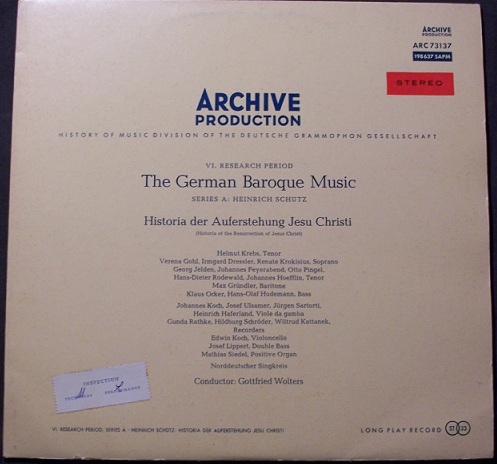
Of course, German publishers may have been slow to add unnecessary frills after the destruction of World War II. Or perhaps buyers of Heinrich Schütz records expected something in a plain brown (or tan) wrapper. The music on both records is quite austere stylistically.
Saturday: May 21, 2011
My local movie theater has been serving delicious hors d’oeuvres (from this restaurant) at their showings of the Metropolitan Opera HD simulcasts. What should they have served for Richard Strauss’ last opera on April 23rd? Carpaccio, of course.
Wednesday: December 29, 2010
In her 2010 Christmas song post on “O Holy Night”, Ann Althouse links back to her 2004 Christmas song post, in which she compared 18 versions of “Blue Christmas”, beginning with Elvis’s, “the best” and imitated by seveal of the others. Although she included a couple of country singers, she somehow missed Ernest Tubb, who first made the song popular in 1949. Apparently, for Althouse, music starts with Elvis. I haven’t heard any of the other 17 versions she lists, much less the 65+ other versions Wikipedia estimates to have been made, but Tubb’s version seems much better than Elvis’s. Perhaps I should say “versions”, since he recorded it at least twice. The later one is much better in that it omits the backup singers.
Fans of bluegrass and other traditional American music all know “The Wreck of the Old 97”. Without even trying, I have acquired five versions by four different artists for my iPod: Ernest Stoneman & Kayle Brewer, Hank Thompson, Johnny Cash (live, at San Quentin), and two by Mac Wiseman. For those who do not know the song, it usually begins something like this:
Well they gave him his orders at Monroe, Virginia,
Saying “Steve, you’re way behind time.
This is not 38, it’s old 97.
You must put her into Spencer on time.”
A complete set of lyrics – more complete than in any version I have heard sung – will be found at the Blue Ridge Institute & Museum website. Most singers start with the third verse, quoted above.
Wikipedia’s article on the wreck and the song includes a detail I had not known:
During the late 1940s, a parody of the ballad was sung that mocked the ties that the folk singer Pete Seeger had to the Communist Party.
They give the first four lines, which is enough for Google to find the rest at the Socialist Songbook website:
THE BALLAD OF PETE SEEGER
(Tune: Wreck of the Old ’97)
Well, they gave him his orders
Up at party headquarters,
Saying, “Pete, you’re way behind the times,
This is not ’38; this is 1947,
And there’s been a change in that old party line.”
Well, it’s a long, long haul
From “Greensleeves” to “Freiheit”,
And the distance is more than long,
But that great outfit they call the People’s Artists
Is on hand with those good old People’s songs.
Their motives are pure, their material is corny,
But their spirit will never be broke.
And they go right on in their great noble crusade –
Of teaching folk songs to the folk.
Wikipedia’s Pete Seeger article doesn’t mention the parody.
Friday: August 27, 2010
The first time I heard the Waco Brothers’ song “The Wickedest City in the World”, I was surprised to hear that the city was Chicago. Not that I had a specific alternative candidate in mind – I just thought that Chicago, while definitely in the Top Ten of wicked cities, was surely not Number One, even among American cities. Lately, I’ve come to realize the Waco Brothers were right, at least on this point.
However, I cannot recommend the song without reserve, because it also contains these lyrics:
I am just a hog,
falling off a log.
Vote for me, or I will kill your dog.
Those may not be the worst lyrics ever written, or even the worst lyrics on my iTunes, but they’re definitely among the Top Ten in that category. (Really bad lyrics usually keep a song entirely out of my music collection.)
Tuesday: February 9, 2010
Does a 125th birthday count as a significant anniversary? If so — also if not — today is Alban Berg’s 125th. In commemoration, I’m playing the only really tolerable pieces written by the New Vienna School, Berg’s Violin Concerto and Lyric Suite for String Quartet. Schoenberg, Webern, and Berg published a few other pieces that are not just tolerable but very pleasant, but they are arrangements of Strauss waltzes — the Old Vienna School reworked by the New — so they don’t really count.
So what would we call a 125th birthday? A hemi-demi-semi-millennium, of course.
By the way, ‘Alban’ seems an odd name for a German. I mostly know it from the name of the Alban Mount, southeast of Rome. It’s odd that ‘Berg’ is German for mount(ain), though the mountain is apparently not called the Albanberg in German. The ancient Roman name is singular, Albanus Mons, but German Wikipedia gives the plural ‘Albaner Berge’ as the preferred form, with ‘Albaner Hügel’ and ‘Albanergebirge’ as alternatives. I still wonder if Alban’s father was indulging in a pun: perhaps a native speaker can tell us.
Friday: June 19, 2009
In Nineteen Eighty-Four, Orwell twice quotes a song popular among the proles of his imagined future, “composed without any human intervention whatever on an instrument known as a versificator”. He calls it “dreadful rubbish” and a “driveling song”, but it seems to me that it would fit right in to the Great American Songbook. Of course, we cannot judge the music, but I have certainly heard worse words. Here are the lyrics, with the proletarian (Cockney) mispronunciations edited out:
It was only a hopeless fancy,
It passed like an April day,
But a look and a word and the dreams they stirred
They have stolen my heart away!
They say that time heals all things,
They say you can always forget;
But the smiles and the tears across the years
They twist my heartstrings yet!
(George Orwell, Nineteen Eighty-Four, II.iv and II.x)
It is not deep, but other than the awkward rhythm of the fifth line, I don’t see anything embarrassingly wrong with it. Do I need a taste-bud transplant?
Sunday: February 1, 2009
The Blogosphere is busy arguing whether Tom Daschle should be approved as Secretary of Health and Human Services, despite being an obvious tax cheat. I would have thought that was a no-brainer: of course not. The question people ought to be arguing is whether he should be hauled away in handcuffs or at least grilled further about his finances, not by the Senate but by someone with the power to indict him. I lean towards ‘yes’ on the second question. Why is no one — or no one of importance — even asking it?
Tuesday: November 11, 2008
I’m not sure why my comments aren’t working, and why I can’t even use FTP. Until I can fix that, readers may contact me by e-mail at the following address, after carefully reversing it: gro.liveewrd@liveewrd.
Sunday: March 30, 2008
I know of three examples of this interesting phenomenon. Can anyone add more?
1. The second stanza of “The Wreck of the Old 97”:
Then he turned around and said to his black, greasy fireman,
“Shovel on a little more coal.
And when we cross that White Oak mountain,
Watch Ol’ ’97 roll.”
On at least one of this albums, Mac Wiseman changes this to “big ol’ greasy fireman”. Of course, the original text has nothing to do with race. Any man who spends his day shoveling coal into the open door of a furnace is going to be black from the soot and greasy as soon as he works up enough of a sweat to mix with the soot. Granted that some firemen may have been black to start with, there’s no reason to suppose that this one was, or that it would have made any difference to the song if he were.
2. One couplet of Bob Wills’ rather disjointed “Take Me Back to Tulsa” reads:
Little bee sucks the blossom, big bee gets the honey,
Dark man picks the cotton, white man gets the money.
On The Archive Series, Vol. 2, Dan Walser changes this to:
Well, the little bee sucks the blossom, but the big bee gets the honey,
The little man raise the cotton, but the big man gets the money.
3. One of Johnny Cash’s best-known lines is this, from “Folsom Prison Blues”:
I shot a man in Reno, just to watch him die.
On Kindred Spirits: A Tribute to the Songs of Johnny Cash, Keb’ Mo’ changes this to:
They say I shot a man in Reno, but that was just a lie.
I can see why a black man might not feel entirely comfortable singing the original lyrics, but the change wrecks the song. It would have been better to pick another song if he couldn’t do this one ‘straight’.
In a post on “Cover songs almost as good as the originals (and sometimes better)”, VodkaPundit writes “‘Nouvelle Vague’ is Portuguese for ‘New Wave'”. Actually, the phrase is French, not Portuguese, and was used to describe the movies* of Godard, Truffaut, and some of their contemporaries long before the band (which I’d never heard of) borrowed the name. According to Wikipedia, the band’s second album was Bande à Part, which is also a 1964 Godard movie, so the name must be homage rather than coincidence.
When the original ‘nouvelle vague’ appeared in the 1950s, the phrase puzzled Evelyn Waugh, who couldn’t tell whether it was supposed to mean ‘new wave’ or ‘vague novel’.
For the subject of VodkaPundit’s post, I nominate Dwight Yoakam’s cover of Baby, Don’t Go (with Sheryl Crow). It’s the best thing on the album Under the Covers. Until I heard it, I hadn’t realized that Sonny Bono had ever written a song that was any good at all. Yoakam’s cover of Kinky Friedman’s Rapid City, South Dakota is (in my opinion) slightly better than the original.
– – – – – – – – – – – – – – – – – –
Yes, I know, I should call them ‘films’ or ‘cinema’. Sorry, not going to do it.
The spine of Volume 5 of The New Grove Dictionary of Music and Musicians lists the contents as ‘Canon to Classic Rock’.
Saturday: February 16, 2008
I don’t believe I’ve ever seen this in manuals of rhetoric or lists of figures of speech, but these three sentences all use the same rhetorical trick:
- Nice we’re having weather, isn’t it?
- What’s a girl like you doing in a nice place like this?
- I’ve got high friends in places all over time.
The last is the title of one of the three good songs on what is apparently the only album by Scott McQuaig. Can anyone quote more examples? I have a feeling I’ve forgotten one or two.
Randall Jarrell describes a student art exhibit at a fictional women’s college (“Benson”):
The students had learned all the new ways to paint something (an old way, to them, was a way not to paint something) but thye had not had anything to paint. The paintings were paintings of nothing at all. It did not seem possible to you that so many things could have happened to a piece of canvas in vain. You looked at a painting and thought, “It’s an imitation Arshile Gorky; it’s casein and aluminum paint on canvasboard, has been scratched all over with a razor blade, and then was glazed–or scumbled, perhaps–with several transparent oil washes.” And when you had said this there was no more for you to say. If you had given a Benton student a pencil and a piece of paper, and asked her to draw something, she would have looked at you in helpless astonishment: it would have been plain to her that you knew nothing about art. By the time a Benton artist got through exploiting the possibilities of her medium, it was too dark to do anything else that day; and most of the students never learned that there was anything else to do.
(Pictures from an Institution, Chapter 6, “Art Night”, section 2)
I was reminded of this by A. C. Douglas’ comments (here and here) on a contemporary composer’s desciption of how he composes his works. He may be a bit unfair to the composer, who does imply that he has to have an idea before he can tinker with it.
Monday: July 30, 2007
Puccini’s Gianni Schicchi, the 2004 Glyndebourne production:
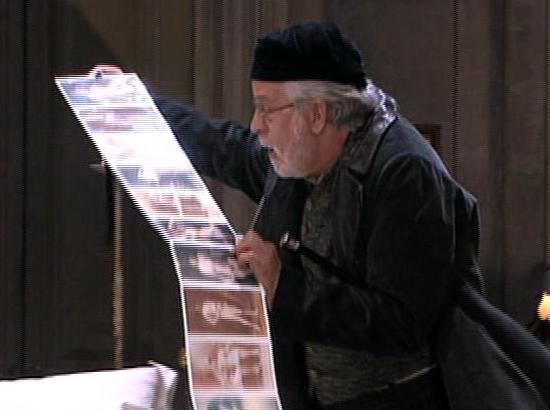
I’ve seen all of Il Trittico once before (on DVD) and found Il Tabarro a terrible bore, Suor Angelica only intermittently interesting, mostly in the bits of church music, and Gianni Schicchi thoroughly entertaining. I wonder why Puccini didn’t do more comedies.
Sunday: March 25, 2007
Perhaps not the most appropriate lyric for a Sunday morning, but I haven’t gone to bed yet from Saturday, and I can’t get the song out of my head:
Arnold was an armadillo
And oh so in need of romance
And it chanced that one Saturday evening
Arnold went to a dance
The moment he walked in the room
He saw her, as if he had known
She’d be there, by the side of the stage
All he wanted, all in black, all alone
She was there, she was his, dressed to kill, oh
if only his glasses were cleaner . . .
He was an armadillo
She was a concertina
He struggled to make conversation
He leap-frogged from topic to topic
If only she’d say something back . . .
If only he weren’t so myopic
Bright silver buttons in rows
From head down to toes in black leather . . .
Could this beauty love him?
“Here goes,” Arnold thought,
“It’s now or never!”
He could picture her head on his pillow
He had loved her the moment he’d seen her
He was an armadillo
She was a concertina
You can’t help but feel for the lad, oh
How happy poor Arnold would be
If they could make love in the shadows
And no one, but no one, would see
Alas, what he hoped might have been a
Sweet secret was soured completely
Sex with a concertina
Is rarely accomplished discreetly
The dancers stopped stripping the willow
It was oh such a loud misdemeanor
He was an armadillo
She was a concertina
Picture love as a kind of concerto
Poor Arnold, his first was unfinished
For what let everyone who was there know
A very loud C sharp diminished
Someone said, “Look, it’s Arnold,”
And he ran from their scorn and their laughter
Into the darkness outside
And never returned ever after
Tales of lost love and dreams unfulfilled, oh
Cruel Cupid, you’ve never been meaner
He was an armadillo
She was a concertina
The song is “Arnold”, by the Austin Lounge Lizards, from their 2006 album The Drugs I Need. I wonder if they read Protein Wisdom? The previous song mentions bloggers. Perhaps I’ll post the lyrics to it as well.
Comments Off on Sunday Song Lyric
Saturday: March 24, 2007
Eve Tushnet has a top-ten post on horror in pop songs. Unfortunately, I’ve never heard of any of the songs, and only one of the performers – Siouxsie and the Banshies – who was (were?) the object of a Beavis & Butt-Head text-and-commentary segment. The last title on the Tushnet list is a song by the Cramps (whoever they are) called “Eyeball in my Martini”. My split-second reaction was “shouldn’t that be ‘Eyeball in my Highball’?”. A Google search shows that a song by that name has already been written, and is available for 50¢ from Lulu. I haven’t decided yet whether to pay for a copy.
Comments Off on Human Autocorrect
Wednesday: March 21, 2007
Charles Rosen, The Classical Style, p. 170:
It was Handel who said that Gluck ‘knows no more counterpoint than my cook’ . . . Tovey has pointed out that Handel’s cook, who was also a singer in Handel’s opera company, probably knew a good bit of counterpoint.
Comments Off on Musical Snark
|
|