|
Powered by WordPress
|
Saturday: October 6, 2012
That someone has been stealing massive quantities of maple syrup in Quebec is certainly news, but not particularly weird. What is weird is what the Fox News story mentions in passing as apparently unremarkable: that the theft occurred at “the province’s global strategic reserve at St-Louis-de-Blandford”. Quebec has a Strategic Maple Syrup Reserve? Do other Canadian provinces? Does Vermont? Perhaps something has gone wrong with a translation from the French, and the reserve is not really “strategic” in the usual English sense. Or perhaps Canadians consider maple syrup an essential wartime resource.
Saturday: November 5, 2011
In a post at The Volokh Conspiracy, Stewart Baker includes a picture of the statue that stands outside the Federal Trade Commission (he credits JoeInSouthernCA):

When I worked in D.C. 20+ years ago, I often walked past the statue. My friends and I liked to think of it as the allegorical depiction of Bureaucracy restraining Trade.
Tuesday: September 20, 2011
As of noon today – right now, if I’ve figured out how to preschedule a post properly – we are two-thirds of the way through Obama’s first and (barring divine infernal intervention) only term. If we can make it through the next year and a third without any more permanent damage, we can begin the huge task of putting things back together. Some prosecutions would be in order, pour encourager les autres, but the next sixteen months are likely to provide plenty of encouragement for despisers of Obama, and discouragement for his dwindling band of admirers. Will the spectacle be terrifying, infuriating, revolting, pathetic, or just tedious? Probably all of the above, and some other adjectives that haven’t occurred to me yet.
Monday: August 8, 2011
I haven’t been able to find the original at the Wall Street Journal site, but commenter ‘Chipper’ writes (on this Pajamas Media Tattler post):
Via WSJ’s Live Blog, Jason Goepfert of Sundial Capital Research writes in with this unhappy note:
“There’s still an hour of trading to go before the close of regular trading hours, but in the interim we’re seeing several breadth- and price-based indications that today is, in effect, a market crash.
“By that, I mean that the level of selling pressure is so great that we’ve witnessed something similar only a handful of times, and they were what most consider to be crashes or at least mini-crashes.
“First, breadth on the NYSE is skewed to the downside to a historic degree (fewer than 2% of stocks are positive on the day). Only 5/13/40 and 5/21/40 had fewer up stocks as a percentage of total stocks than today does. Yes, it’s been 70 years since it has been this bad.”
The dates mentioned are interesting. What was going on in U.S. and the world on May 13th and 21st, 1940, to explain two such disastrous stock market days?
What was going on was World War II. May 10th, 1940 was the day Nazi Germany invaded France and the Low Countries, Chamberlain resigned, and Churchill became Prime Minister. As I suspected as soon as I noticed the three days difference between these events and the stock-market slide in New York on the 13th, there was a weekend in between. May 10th was a Friday, so the 13th was the first full trading day after the ‘Phony War’ turned into a very real hot war, with the German Blitzkrieg making rapid progress through the Low Countries. The 13th was also the day the Germans broke through the French defenses around Sedan, though that was probably not known to the stock-trading public. Churchill’s “blood, toil, tears, and sweat” speech was also on the 13th.
The only New York Times front page I have been able to find for the period is from the 15th. The headlines are:
DUTCH END RESISTANCE EXCEPT IN ZEELAND
NAZIS TAKE SEDAN, STRIKE AT FRONT LINE;
SUFFER HEAVY LOSSES IN FURIOUS ATTACK
It looks as if newspapers were a couple of days behind events on the ground, and spinning things for the Allies as best they could.
By Tuesday, the 21st, the second stock-market disaster day, Queen Wilhelmina had fled to England (on the 13th), Rotterdam had been destroyed by German bombers (the 14th), the Dutch had surrendered (the 17th), and German tanks had reached the Channel (the 20th), cutting off the British Expeditionary Force, the French 1st Army, and what was left of the Belgian Army from the main body of the French Army. Again, I do not know whether the splitting of the Allied lines was known to newspaper readers in America by the close of the trading day on the 21st, but everyone must have known by then that the Allies were losing, and losing badly, after only a week and a half of full-scale hostilities. (I imagine the French and British stock markets – not to mention the Dutch and Belgian – were dropping even farther and faster than the NYSE, but that’s irrelevant here.)
What can we conclude? When it comes to wrecking the NYSE, Obama’s administration and its enablers (of both parties) in Congress have arguably been more destructive than anything since the darkest days of World War II. If Chipper’s source is right, Obama’s debt downgrade has been worse for the economy than Pearl Harbor. Heck of a job, Barry! Time to take a hint from Neville Chamberlain and resign? Not that Joe Biden has any resemblance to Winston Churchill . . . . We’re screwed.
Thursday: July 21, 2011
Yesterday, Dustbury and Ann Althouse blogged the death of Alex Steinwess, who invented the album cover in 1939. Before that, “[t]he covers were brown, tan or green paper. They were not attractive, and lacked sales appeal.” (So Steinwess, quoted by Dustbury.)
Some countries were quicker to improve the esthetics of their album covers than others. These two were published as late as 1958 and 1961 respectively:

Of course, German publishers may have been slow to add unnecessary frills after the destruction of World War II. Or perhaps buyers of Heinrich Schütz records expected something in a plain brown (or tan) wrapper. The music on both records is quite austere stylistically.
Saturday: May 21, 2011
My local movie theater has been serving delicious hors d’oeuvres (from this restaurant) at their showings of the Metropolitan Opera HD simulcasts. What should they have served for Richard Strauss’ last opera on April 23rd? Carpaccio, of course.
Wednesday: December 29, 2010
Fans of bluegrass and other traditional American music all know “The Wreck of the Old 97”. Without even trying, I have acquired five versions by four different artists for my iPod: Ernest Stoneman & Kayle Brewer, Hank Thompson, Johnny Cash (live, at San Quentin), and two by Mac Wiseman. For those who do not know the song, it usually begins something like this:
Well they gave him his orders at Monroe, Virginia,
Saying “Steve, you’re way behind time.
This is not 38, it’s old 97.
You must put her into Spencer on time.”
A complete set of lyrics – more complete than in any version I have heard sung – will be found at the Blue Ridge Institute & Museum website. Most singers start with the third verse, quoted above.
Wikipedia’s article on the wreck and the song includes a detail I had not known:
During the late 1940s, a parody of the ballad was sung that mocked the ties that the folk singer Pete Seeger had to the Communist Party.
They give the first four lines, which is enough for Google to find the rest at the Socialist Songbook website:
THE BALLAD OF PETE SEEGER
(Tune: Wreck of the Old ’97)
Well, they gave him his orders
Up at party headquarters,
Saying, “Pete, you’re way behind the times,
This is not ’38; this is 1947,
And there’s been a change in that old party line.”
Well, it’s a long, long haul
From “Greensleeves” to “Freiheit”,
And the distance is more than long,
But that great outfit they call the People’s Artists
Is on hand with those good old People’s songs.
Their motives are pure, their material is corny,
But their spirit will never be broke.
And they go right on in their great noble crusade –
Of teaching folk songs to the folk.
Wikipedia’s Pete Seeger article doesn’t mention the parody.
Tuesday: October 26, 2010
In a quick search, I have found nothing about this on the web. For the past two or three months, someone has been parking white semi-trailers around the central Shenandoah Valley, with political messages painted on them. They’re not always in the same place, and I’ve seen them in Harrisonburg and Rockingham County, mostly along I-81, also on I-64 in Augusta County between Staunton and Waynesboro. With the state of the economy, I suspect it didn’t cost all that much to rent the trailers, assuming they did not already belong to whoever is responsible for the messages.
I wish I had had my camera along the last time I drove from Staunton to Harrisonburg, since I saw three of them, two on I-81 and one on Port Republic Road. Here is a picture taken on the fly by fellow-Stauntonian Andrea Harris of Spleenville a month or two ago:
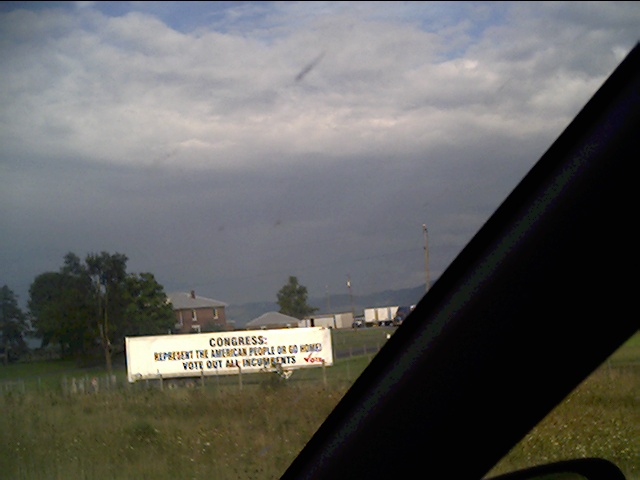
Here are all of the messages I’ve seen so far. I don’t know if there are five trailers, or more, or if some have been repainted with different messages at different times:
Congress:
Represent the American People or Go Home!
Vote Out All Most Incumbents ✔ote
– – – – – – – – – – – –
Congress: Have You Read Our Constitution?
Vote Out All Most Incumbents ✔ote
– – – – – – – – – – – –
Congress: Why All the Arrogance?
You Work For Us
Vote Out All Most Incumbents ✔ote
– – – – – – – – – – – –
What You Promised While Campaigning
Should Be What You Do When Elected
Vote Out All Most Incumbents ✔ote
– – – – – – – – – – – –
Congress: You Have Failed Us
Vote Out All Most Incumbents ✔ote
If I recall correctly, they originally said “Vote out all incumbents”, without the “most” (which is sometimes written above the “all”, sometimes across it, as in the picture). I wonder which incumbents have since won the author’s support. The most obvious guess would be our local congressman, Bob Goodlatte (R – 6th district), whose positions seem more in tune with the truck messages than most of Congress. I also wonder whether the trucks are the work of (a) one pissed-off voter with money to spend, or (b) one pissed-off businessman with plenty of idle trailers and idle painters and enough money left to pay for paint, or (c) a whole group of pissed-off voters. I’ve certainly never seen anything like it in previous election years, at least on this scale. I do recall a bumper-sticker I saw in Monterey, California in 1966, when Reagan defeated Pat Brown: “If It’s Brown, Flush It”. It made a big impression on my then 13-year-old self, but may have been a one-of-a-kind.
Update: (8:15pm, Halloween)
Here’s the message on the sixth trailer:
America does not need new parties
It needs new candidates
Vote Out All Most Incumbents ✔ote
Thursday: August 26, 2010
Megan McArdle writes:
The economy is at best heading into a soft patch; at worst it is going into the second dip of a double-dip recession.
This is not the worst possibility, rather the middle one of three. McArdle’s dichotomy should be a trichthotomy, split three ways (not a ‘trichotomy’: that would be the act of splitting hairs). As some of her commenters point out, we may be well on our way into a full-scale depression. I have seen no sign of bottoming out, much less recovery, either temporary (in a double dip) or permanent. To put it another way, she and others have wondered whether this recession will be V-shaped (short and sharp, which is good), U-shaped (protracted, and not-so-good), or W-shaped (double-dip, even worse). There are other letters in the alphabet, and other characters in the HTML character set. Rather than one of these:
V – U – W
I wonder whether we might be looking at a drop to a permanently lower level, with no recovery:
L
or perhaps a continuous downhill slide:
\
or perhaps a steep drop with no visible bottom:
⌉
As with ice cream, a double dip is a pleasant prospect, compared to many of the alternatives.
Sunday: July 25, 2010
In Reason, Peter Suderman (þ InstaPundit) writes that the Federal budget is “in terrible shape”, and none of the 212 comments (so far) notes that that’s like saying the Passenger Pigeon is “endangered”. There is no federal budget, because Congress hasn’t bothered to pass one, and has no plans to pass one. Shouldn’t newspapers and other media have running clocks labeled “It is XXX days past the deadline, and Congress still hasn’t passed a budget”?
I read somewhere a few weeks ago that New York state legislators hadn’t been paid since April (I think it was), since they hadn’t passed a state budget, but that they will be paid in full once they do. It seems to me that we need a similar law for federal legislators, but without the retroactive part. Why should we pay them if they can’t, or won’t, do their job?
I also wonder if it would be possible to adjust their pay for the size of the deficit. If they pass a budget (or don’t pass it) in which federal income is only covering 60% (or whatever) of federal outlays, why should Congressmen get more than 60% of their salaries? Of course, the problem is to avoid giving them incentives to destroy the economy with (e.g.) massive tax increases in order to safeguard their salaries. Perhaps their salaries should be inversely related to total outlays. Of course, the even larger problem would be convincing them to pass laws that would punish them for not doing their jobs. For that, an amendment to the Constitution might be needed. How humiliating would that be, to Congress and the nation as a whole?
Sunday: July 4, 2010
A Volokh Conspiracy post puts me in mind of Suetonius. Jonathan H. Adler reports that the White Castle hamburger chain says that “a single provision” of the recently-passed health insurance reform bill “will eat up roughly 55 percent of its yearly net income after 2014”. In the comments many people sneer at the claim, insisting that White Castle is run by greedy plutocrats who could easily afford the new expenses and are simply lying about the costs of the bill.
That reminded me of a favorite saying of the emperor Domitian. As Suetonius put is (Life of Domitian 21):
He used to say that the lot of princes was most unhappy, since when they discovered a conspiracy, no one believed them unless they had been killed.
Let’s hope we don’t find out how bad the health reform bill is only after it has killed off White Castle and other useful corporations, large and small.
Saturday: May 1, 2010
An economist is a surgeon with an excellent scalpel and a rough-edged lancet, who operates beautifully on the dead and tortures the living.
(Products of the Perfected Civilization: Selected Writings of Chamfort, tr. W. S. Merwin, San Francisco, 1969, p. 185)
Friday: January 1, 2010
I would feel a lot better about Megan McArdle’s latest post if it were titled “Looking Ahead to Health Care Reform” instead of “Looking Forward to Health Care Reform”. No one I know is looking forward to it.
Tuesday: December 22, 2009
If you’re looking for a snow shovel three days into a blizzard: Home Depot. Martin’s (our local high-end grocery chain) sold out on Friday, when the blizzard was just getting started. By Monday, Walmart had been out of snow shovels for quite some time. They suggested I try Home Depot, which had large quantities of four different models, all very reasonably priced: the cheapest was $12.95, the most expensive $22.95. I bought the $19.95 model, since it had a metal blade and the other three were all plastic. I probably should have thought about buying a snow shovel earlier, but I rent, so clearing the sidewalk is the landlord’s problem. Of course, getting my car out from under two feet of snow was my problem. I did most of that myself, with just a window scraper, but paid a couple of guys $10 to finish the job. I would show you a picture of the snow shovel I bought, but searching for ‘snow shovel’ on the Home Depot site brings up only snow blowers and snow blower accessories.
Sunday: November 1, 2009
The only really inexpensive cheese at Whole Foods last time I was there was Höfdingi, which I would describe as a very smooth Brie, only elliptical instead of round. It was well worth the price I paid: $2.99 for 150g. I was not surprised that an Icelandic cheese was so reasonably priced, given what has been happening to the Icelandic economy lately. It’s too bad that economic meltdown rarely has a silver lining for the people directly affected.
Tuesday: August 18, 2009
Eugene Volokh quotes M. I. Finley’s warning about the unreliability of numbers in ancient authors:
Even the rare figure to which an ancient author treats us is suspect a priori …. [W]hen Thucydides (7.27.5) tells us that more than 20,000 slaves escaped from Attica in the final decade of the Peloponnesian War, just what do we in fact know? Did Thucydides have a network or agents stationed along the border between Attica and Boeotia for ten years counting the fugitives as they sneaked across? This is not a frivolous question, given the solemnity with which his statement is repeated in modern books and then used as the basis for calculations and conclusions.
In the comments, Stephen C. Carlson asks “Yikes, how does one know that the figures survived the manuscript transmission by manual copying intact?”. How, indeed? Here’s is just a bit of what H. W. Smyth’s Greek Grammar (revised edition, 1956) has to say about Greek numerical symbols:
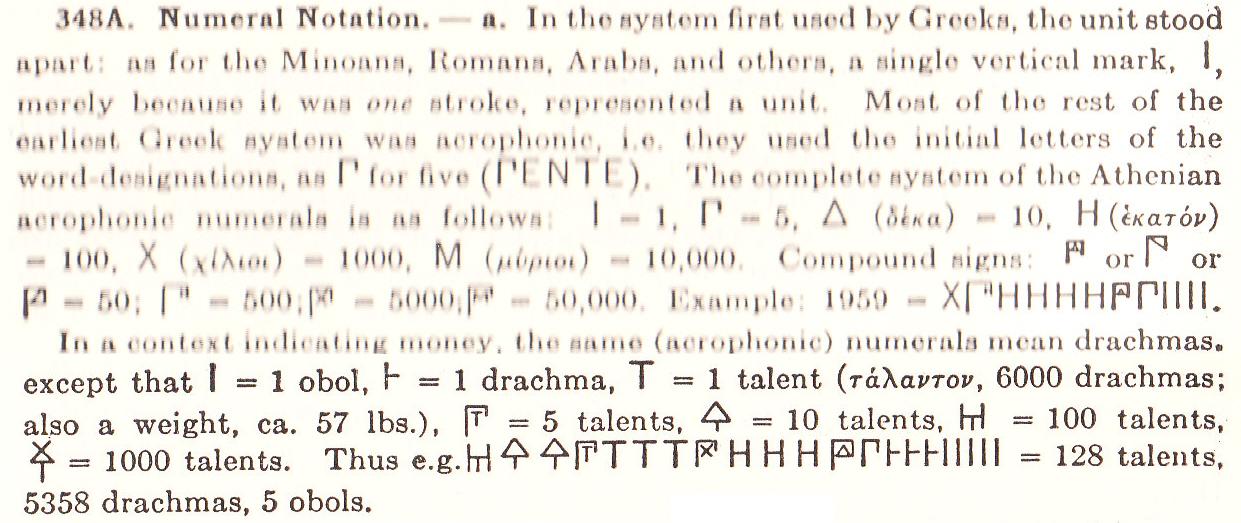
Sorry if the top part is illegible: the book is too fat to scan comfortably, so the part from the left-hand page came out very pale and blurry. The problem should be clear, even if the text is not. By the way, I’d never noticed before, but this quotation is from pages 104 and 104A. The rest of the book is numbered normally from i to xviii and then from 1 to 784, but there are extra pages 4A, 4B, 104A, and 104B. (Not that I’ve checked every page, of course: there may be other interruptions to the numerical sequence.) Apparently the 1956 revisions involved inserting some extra pages without resetting the entire work.
Here is something on Roman numerical symbols, from Gildersleeve and Lodge’s Latin Grammar (3rd edition, 1895, p. 52):
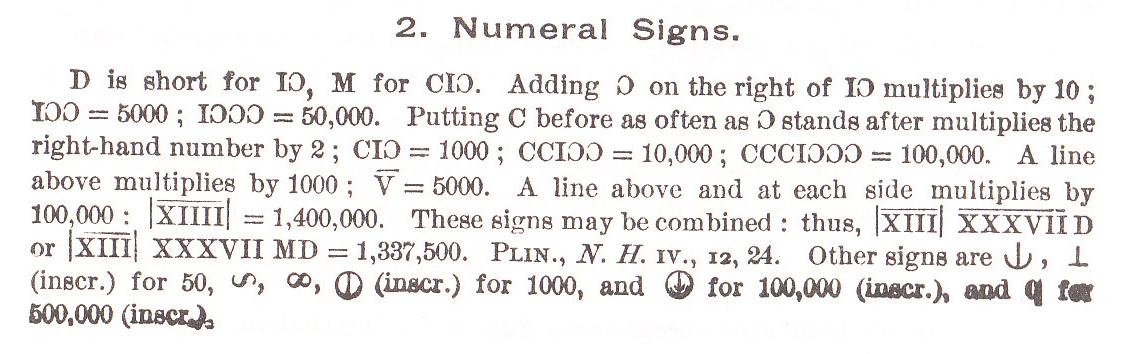
It’s amazing that ancient politicians and businessmen could do their books at all.
Tuesday: November 11, 2008
I’m not sure why my comments aren’t working, and why I can’t even use FTP. Until I can fix that, readers may contact me by e-mail at the following address, after carefully reversing it: gro.liveewrd@liveewrd.
Monday: May 26, 2008
Two entries in Flaubert’s catalogue of inane clichés, the Dictionnaire des Idées Reçues (Dictionary of Accepted Ideas, tr. Jacques Barzun) are depressingly familiar:
Importation: Ver rongeur du commerce.
Imports. Canker at the heart of Trade.
Libre-Échange: Cause des souffrances du commerce.
Free Trade: Cause of all business troubles.
Sunday: May 25, 2008
InstaPundit quotes an AP story claiming that the cost of a package of hot dogs is up almost 7% in the last year to $4.29. I paid 99¢ each for my last two packs, on sale at Food Lion. Hot dogs keep for months in the refrigerator and years in the freezer, so there’s no reason ever to pay full price. What brand did I buy, and what kind of animal(s) were they made from? Who cares? Anyone who worries about the precise ingredients of his food shouldn’t be eating hot dogs in the first place. Even the priciest dog is, as Mencken put it, “a cartridge filled with the sweepings of the abattoir”. And even the cheapest dog tastes OK when broiled until semi-crispy.
As for buns, I put my hot dogs on semi-toasted folded white bread, with plenty of ketchup, mustard, and minced fresh onion. Even the traditional short stubby hot dogs stick out of the pseudo-bun on both ends as they ought to, and the bread holds the condiments at least as well as a bun, whose hinges tend to break under the strain of a well-slathered dog. Of course, bread is also generally cheaper than dedicated hot dog buns, and works well for hamburgers, too, especially if they’re square.
Saturday: September 15, 2007
Joanne Jacobs links to a sad story about five South Korean autoworkers who were fired by Hyundai for not being high-school graduates: they were actually college graduates. My comment there seems worth posting here as well, with a bit of editing:
I’ve been fired from a job for having a college degree, and I hadn’t even applied for it. I was actually just a thesis away from my M.A. at the time. I was between regular jobs in a recession — the Carter administration was one long recession, as far as I could see –, and working intermittently for Manpower. Some of their temp jobs were quite pleasant: working as a flagman for the phone company out in the country when it’s 68 degrees and breezy is very nice, except for the lack of bathrooms.
One week they sent me to Pepsi to help deliver sodas all around the county — including to two prisons (men’s and women’s) and a home for the criminally insane, which was interesting.* On Wednesday of that week, I was told I was fired (by Pepsi, not Manpower). Apparently they were using Manpower to try out possible permanent employees and just assumed I would be interested in signing on full-time. (I’m a Coke drinker myself, and wouldn’t have felt comfortable in a career delivering a product I dislike. Then again, I had the impression the pay was pretty good, so I might have considered it.) They apparently had an unwritten no-college-graduates rule. I certainly didn’t go around telling blue-collar workers I’d been to college and even grad school, and was annoyed that the Pepsi driver wormed the information out of me and then blabbed about it to his boss. He had begged me not to tell his boss about his back troubles so he wouldn’t be fired, and I kept that promise, even after being fired myself, though I was sorely tempted to get a little payback.
*The driver told me to be especially careful delivering sodas to the juvenile wing in the last place. He had had to chase a kid 100 yards down the hall to retrieve three cases of sodas the previous week. What was particularly impressive was that the kid was wearing handcuffs at the time.
|
|